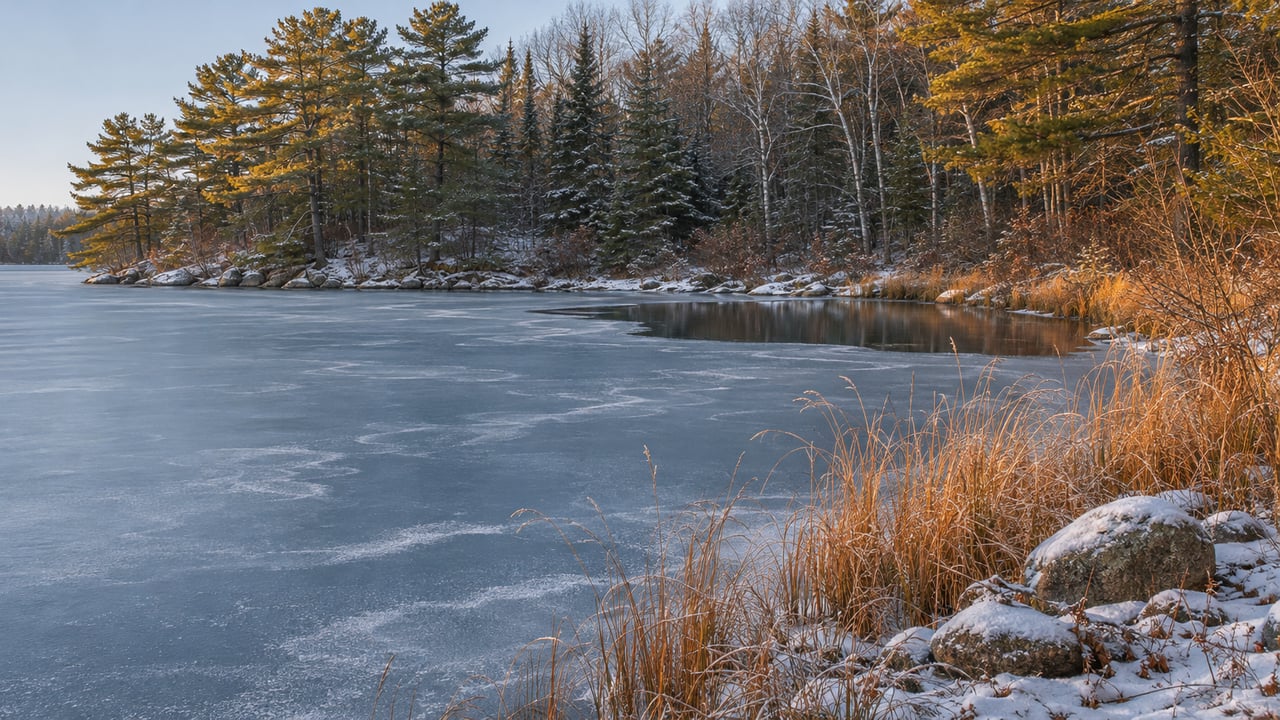
The Minnesota DNR's ice-in record puts Gull Lake's median freeze-up at December 1, five days after Thanksgiving. The DNR defines ice-in as the day the whole lake first freezes over and stays covered for the rest of the winter. Observers do not measure thickness, and the agency states plainly that an ice-in date is not a measure of recreational safety.
That definition is the key to the Gull Chain calendar. The date the open water disappears off Nisswa and the date the ice can hold 10,000 people on Hole-in-the-Day Bay are separate events. The space between them has ranged from comfortable to too short over the past three winters. On February 6, 2027, the Brainerd Jaycees Ice Fishing Extravaganza goes back on Gull Lake, and the record shows that the date it ends up keeping depends far more on January than on whenever Gull happens to close.
Thirty-six winters of freeze-up dates
The DNR's Gull Lake ice-in observations cover 36 winters between 1955 and 2018, with gaps. Compiled from those records, the earliest freeze-up was November 14 in the winter of 1959–60 and the latest was December 22 in 1998–99. The last recorded winter, 2017–18, froze on December 8.
Sorting those dates by era is more useful than any single median. Thanksgiving falls on November 26 this year, and the table counts how many recorded winters in each stretch had Gull frozen over by that date.
| Winters on record | Number of winters | Ice-in range | Frozen by Nov. 26 |
|---|---|---|---|
| 1955–56 through 1968–69 | 14 | Nov. 14 to Dec. 10 | 2 |
| 1969–70 through 1978–79 | 10 | Nov. 14 to Dec. 6 | 5 |
| 1998–99 through 2008–09 | 11 | Nov. 30 to Dec. 22 | 0 |
| 2017–18 | 1 | Dec. 8 | 0 |
In the 1970s, half the recorded winters had Gull closed before the turkey came out. The most recent full run of observations has none. That run, the eleven winters from 1998–99 through 2008–09, never froze earlier than November 30, and three of them, 1998–99, 1999–2000 and 2001–02, held out until December 20 or later.
Gull froze over in the first week of December in plenty of years, and that matches the DNR median. The tail of late freeze-ups has gotten longer, though, and a Gull Lake still showing open water on Thanksgiving weekend is the normal case in recent records.
Hole-in-the-Day Bay keeps the season's real deadline
Freeze-up is the start of the season. The Extravaganza sets the date most of the region watches, and in some years January has not built enough ice on the bay to meet it.
In January 2016, the Brainerd Dispatch reported that sheriff's office crews took 60 measurements on Hole-in-the-Day Bay and found 7 to 13 inches of inconsistent ice, and the contest moved from January 23 to its alternate date. The alternate date was February 6, the same calendar date the Jaycees have set for 2027. The same Dispatch story recorded postponements in 2002 and 2012 and a one-year move from Gull to Round Lake in 2006.
Three winters, three different Februaries
The last three contests show the range of what Gull's ice can do between freeze-up and early February.
| Contest | Date | What the ice did | Ice-out that spring |
|---|---|---|---|
| 2024 | Feb. 3 | Too thin on the bay; held as a multi-lake hybrid | March 17 |
| 2025 | Feb. 1 | Two feet thick; contest area shifted for a pressure ridge | April 18 |
| 2026 | Jan. 31 | Ideal conditions on Hole-in-the-Day Bay |
2024. In late January, the Echo Journal reported that the ice on Hole-in-the-Day Bay was still about six inches short of what organizers were waiting for, with daytime highs forecast in the 30s and overnight lows in the 20s. Crow Wing County measurements that week across Gull, Round and North Long lakes ranged from 8.5 to 11.5 inches. Sgt. Brad Thesing of the sheriff's office advised foot traffic only and avoiding crowds. The contest went ahead on February 3 in a hybrid format logged through the FishDonkey app and spread across several area lakes. Support stations were set up at Hole-in-the-Day Bay and Ernie's on Gull, Nisswa Lake, Round Lake, two accesses on North Long Lake, Jones Bay on Pelican Lake, and Roy Lake. That spring Gull went out on March 17, against May 4 the year before.
2025. Thickness was no problem the next year. An official check on January 24 measured 24 inches, according to the Brainerd Dispatch. The contest ran Saturday, February 1, on Hole-in-the-Day Bay in snow and wind, with gusts up to 39 mph and a wind chill around 10 degrees. Organizers moved the contest area closer to shore within the bay to avoid a large pressure ridge. Thick ice on Gull still moves, and a ridge can rearrange a layout that has been planned for months.
2026. Last winter the 36th annual contest ran Saturday, January 31, on Hole-in-the-Day Bay in sunshine, with temperatures well above zero. The Dispatch described conditions as ideal, "unlike last year." Thomas Johnson of Brainerd won with a 5.63-pound walleye taken in 48 feet of water.
Those three winters produced thin ice that split the contest across several lakes, two feet of ridged ice and a clean bluebird day, and none of the three could have been read from a freeze-up date. The 2027 contest sits on February 6, later than any of those three dates, so it has about one more week of January cold to build on.
Between freeze-up and February 6
Small lakes tend to firm up first. In its December 2, 2025 conservation officer roundup, the DNR reported that smaller lakes around Brainerd were starting to ice up while the larger lakes still had variable or thin ice. Gull is one of the larger lakes on that list, so the small lakes closer to Nisswa will usually firm up before the main basin.
For anyone timing a first trip out on Gull, these are the reference points the record supports:
- Treat the ice-in date as the start of the count. The DNR median of December 1 marks when Gull typically closes, and it carries no information about thickness.
- Measure against the DNR's general guidance of 4 inches of new clear ice for walking, and double that for white ice. The agency stresses that thickness varies across a single lake.
- Watch the county's January checks. The Crow Wing County Sheriff's Office measures Gull, Round and North Long ahead of the Extravaganza, and those numbers are reported in the Echo Journal and the Dispatch.
- Expect pressure ridges even on thick ice, as Hole-in-the-Day Bay showed in 2025.
If you would rather someone else set the house on the ice, Ice Guys rents heated fish houses on Gull Lake for the day or overnight. Extravaganza tickets for February 6 are on sale through the Brainerd Jaycees.
Gull's winter also shapes what owning on the chain is like, from how a cabin is closed up in fall to whether it stays in use through February. Our Nisswa and Gull Chain neighborhood page and our earlier piece on choosing between a cabin and a year-round home on Gull Lake cover that side of the lake.
If you are deciding whether a Gull Chain place should work as a four-season home or stay a summer cabin, Sandy Smith Lakeshore Real Estate Group can show you how the bays, accesses and shoreline you are considering hold up after ice-in. Schedule a Free Consultation.